If you are assessing the return on training and induction videos, it helps to start in the right place. The ROI is not just about whether a video is cheaper than holding another face-to- face session. It is about what poor induction and inconsistent training are already costing you in lost time, avoidable risk, repeated supervision and slower ramp-up.
The cost of getting it wrong
The wider cost picture is already significant. The HSE says workplace injury and ill health from current working conditions cost Great Britain an estimated £22.9 billion in 2023/24, with 40.1 million working days lost in 2024/25. Of that total, £4.3 billion fell directly on employers.
That is the national picture. On site, the cost is usually felt more directly.
A new starter who needs constant shadowing. A supervisor repeating the same explanation across shifts. A preventable mistake that slows output. A near miss that turns into a formal investigation. A process that exists on paper, but not consistently in practice.
Where risk really sits
This is where induction quality matters most. The HSE is very clear that workers are as likely to have an accident in their first six months at work as during the whole of the rest of their working life.
That point alone changes how you should think about ROI. If your highest-risk period is the earliest phase of employment, then better induction is not a soft HR improvement. It is a practical control measure.
There is also a straightforward cost-per-incident argument. HSE cost models estimate the employer cost of a non-fatal injury with seven or more days’ absence at around £7,500 per case, rising to around £10,000 for cases of work-related ill health.
You do not need many avoidable incidents, absences or failures in understanding for the economics of better training to become obvious.

Higher risk in operational environments
For warehouse, logistics and operations teams, the exposure is not theoretical.
HSE’s latest industry comparison shows that transportation and storage has a statistically significantly higher rate of self-reported non-fatal workplace injury than the all-industry average.
That is the environment most induction processes are trying to support.
The cost of inexperience
There is also clear evidence that risk is concentrated around new and less experienced workers.
A large-scale injury analysis by Travelers, an American insurer, found that employees in their first year on the job account for around 36% of injuries and 34% of overall claim costs. The same report found that injured employees missed an average of 80 workdays per injury.
That matters because most induction problems are not caused by a total lack of training. They are caused by inconsistency.
One supervisor explains it one way. Another misses a step. A document exists, but nobody reads it properly on shift. Over time, your training standard becomes dependent on who happens to be available that day.
Knowledge is leaving the business
Alongside this, workforce demographics are shifting. Research in manufacturing shows the proportion of employees aged 55 and over has more than doubled over the last two decades.
At the same time, businesses are dealing with a constant flow of new starters who need to get up to speed quickly.
So there’s a risk of knowledge loss too.
When experienced operators leave, the detail of how a process is actually carried out often goes with them. That affects productivity, not just compliance.
Consistency is where value is created
This is where training and induction videos start to show their value.
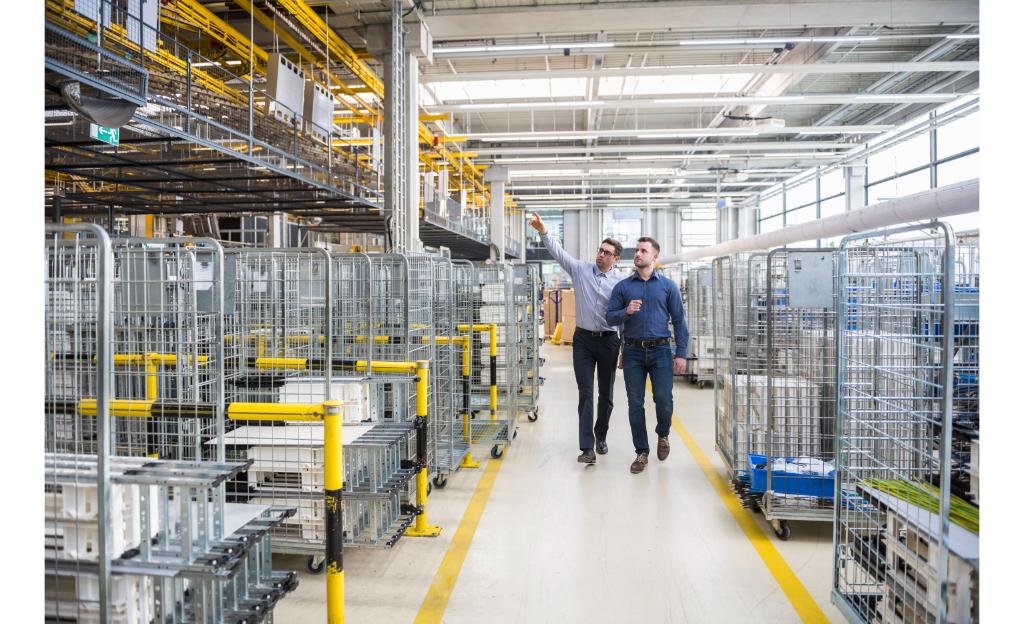
Well-made video content gives you one version of the process, delivered clearly, in your environment, using your equipment and your safe working methods.
It removes variation at the point where variation causes the most problems.
Induction. Process training. Refresher training.
Instead of relying on memory, interpretation or whoever happens to be available to train, your team works from a consistent reference point.
Faster onboarding and less repetition
There is also a straightforward operational benefit.
Supervisors spend less time repeating the same explanations. New starters arrive on the floor with a clearer understanding of what is expected. Refresher training can be delivered quickly without pulling people away from production.
That does not just improve efficiency. It improves confidence across the team.

Protecting productivity as well as safety
In manufacturing and complex operations, time to proficiency matters.
If it takes longer for someone to perform a task correctly and confidently, the cost shows up in output, quality and supervision effort.
Video does not solve that on its own. But it gives you a practical way to capture and transfer knowledge at scale, in a format people can actually use.
That is where the productivity gain sits.
Where the ROI comes from
It builds across several areas:
• Fewer preventable errors and incidents
• Less time spent repeating training
• Faster, more consistent onboarding
• Better retention of site-specific knowledge
Individually, these gains can feel marginal. Together, they are significant.

Where professional support adds value
At Super Motion, this is exactly how we approach training video.
We take your SOPs, induction material and operational processes, then convert them into structured video content that works in a real environment. That means clear storyboarding, efficient filming and content designed to be used on the floor.
To find out more about our training and industrial video production service, please book a no-obligation free 30-minute strategy call or email us at hello@supermotion.co.uk.